


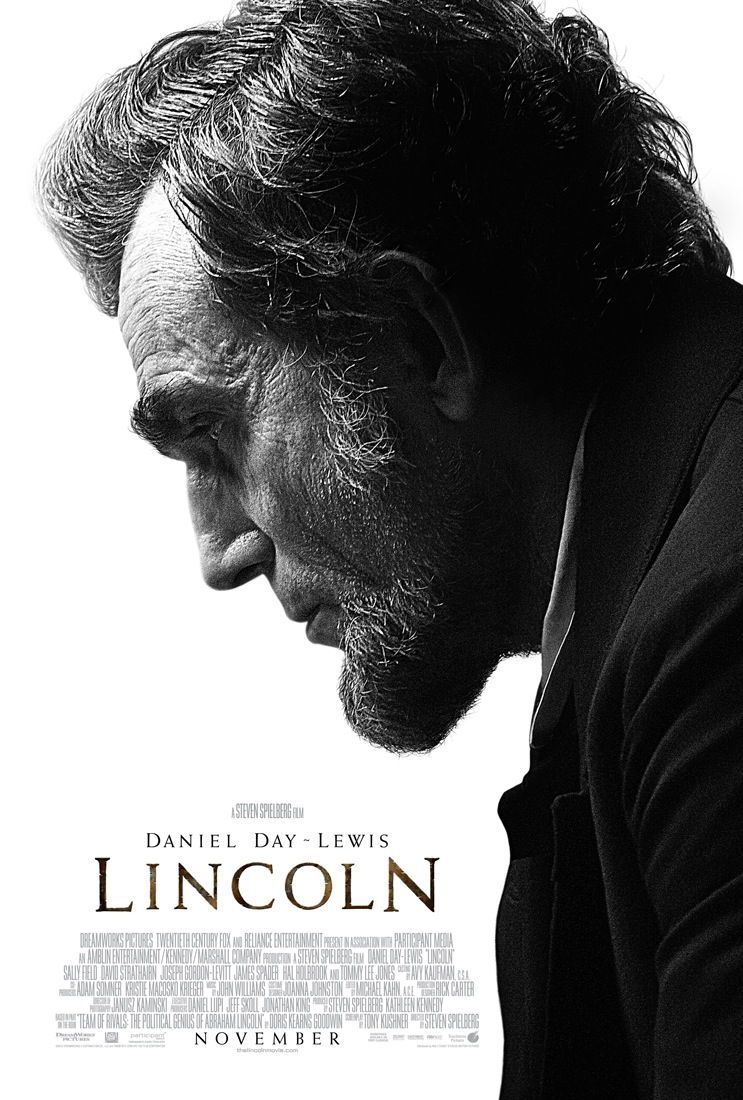
★ ★ ★ ★ 1/2 out of 5 buckets | Matinee and DVD
Rated: PG-13 Intense scenes of war violence, brief strong language and some images of carnage
Release Date: November 9, 2012
Runtime: 2 hours 29 minutes
Director: Steven Spielberg
Writers: Tony Kusher, from the book by Doris Kearns Goodwin
Cast: Daniel Day-Lewis, Sally Fields, David Strathairn, Joseph Gorden-Levitt, James Spader, Hal Holbrook, Tommy Lee Jones, John Hawkes, Jackie Earle Haley, Bruce McGill, Tim Blake Nelson, Joseph Cross
Writers: Tony Kusher, from the book by Doris Kearns Goodwin
Cast: Daniel Day-Lewis, Sally Fields, David Strathairn, Joseph Gorden-Levitt, James Spader, Hal Holbrook, Tommy Lee Jones, John Hawkes, Jackie Earle Haley, Bruce McGill, Tim Blake Nelson, Joseph Cross
SYNOPSIS: As the Civil War continues to rage, America's president struggles with continuing carnage on the battlefield and as he fights with many inside his own cabinet on the decision to emancipate the slaves.
REVIEW: Steven Spielberg, a director who does not need me to list his resume of superior films (War Horse, Schindler's List, E.T.: The Extra-Terrestrial), returns to direct a historical film about his favorite United States President - Abraham Lincoln. Munich writer Tony Kusher developed the screenplay, based in part on the Doris Kearns Goodwin book "Team of Rivals: The Political Genius of Abraham Lincoln".

In the months after the battle at Gettysburg, Abraham Lincoln (Daniel Day-Lewis, There Will Be Blood) surveys more battlefields and meets with more Union soldiers of all colors. Now in his second presidential term and knowing that his war-time Emancipation Proclamation would not hold up if the war with the South ended, Lincoln looks to pass into law the 13th Amendment of the Constitution as quickly as possible – even before his second term inauguration. Already passed in the House of Representatives, Lincoln must have the amendment brought to the floor of the Senate. Without a guaranteed 2/3rd majority to pass the amendment, Lincoln and his Secretary of State William Seward (David Strathairn, The Bourne Legacy) hatch a political plan to acquire the necessary opposing democratic party member votes using a slick and unsavory group of outsiders including W.N. Bilbo (James Spader, Boston Legal) and Richard Schell (Tim Blake Nelson, Big Miracle), cozying up to Washington Republican insider Preston Blair (Hal Holbrook, Water for Elephants) in exchange for the promise of sending emissaries to President Jefferson Davis to broker a deal to end the war, and trying to reel in the Republican Senator Thaddeus Stevens (Tommy Lee Jones, Hope Springs) to keep his passion for equal rights focused on legal equality, not racial equality. Faced with the prospect of ending the war or passing the constitutional amendment, Lincoln walks a razor’s edge to try to achieve both.
Steven Spielberg's Lincoln is a history lesson of our sixteenth president and the pursuit of the 13th amendment of the Constitution of the United States. From the months after the bloody battles of Gettysburg to his eventual untimely and tragic death at the hands of an assassin’s bullet, Abraham Lincoln looked to change American history. A staunch opponent of the idea and practice of slavery, Lincoln made it his goal to abolish the trade within his administration. Using the civil war to enact war powers in the executive branch, Lincoln's law savvy allowed him to write up and institute the Emancipation Proclamation and free slaves based on the facts that slaves were property of enemy rebels. Lincoln knew that his proclamation would not stand up in a court of law once the war ended, he made it mission of the advent of his second term (even before his inauguration) to bring the amendment to the Senate in an attempt to pass the amendment proposal in front of a congressional Senate not favorable to its passing.
Lincoln struggled with the freedom and equality of its nation's people, while its people comprised a country divided in bitter civil war. Lincoln battled with his own cabinet on the topic of freeing the slaves forevermore, while his cabinet was more concerned with freeing the country’s citizen’s from a ravaging war over freeing a race of individuals most citizens deemed inferior. But Lincoln was resolute in his beliefs for equality and an unified nation. This film focuses on all of the President's efforts and his belief that the passing of the 13th Amendment was critical to the future of America, taking part in closed-door politics and using 'consultants' to broker hand-shake and under-table dealings. The President even keeps his closest advisers and his own wife Mary (Sally Field, The Amazing Spider-Man) guessing.
Daniel Day-Lewis embodies the 16th President of the United States as if this was the role he was meant to play. With some prosthetics, his own physical stature, and his ability to become any character, Day-Lewis becomes the definitive Lincoln. Spielberg shines the light, through Day-Lewis, on a man who was earnest, thoughtful, savvy, quick with an anecdote or story, and troubled with the weight of his office, his family, and a divided nation. Spielberg also fills the film with dozens of solid and A-list actor. Along with Tommy Lee Jones, Sally Field, David Strathairn, and James Spader, Lincoln also boasts Jackie Earle Haley (Dark Shadows) as the Confederate's Vice President Alexander Stephens, Joseph Gordon-Levitt (The Dark Knight Rises) as young Robert Lincoln wanting to serve in his father's army, Jared Harris (Sherlock Holmes: A Game of Shadows) as Ulysses S. Grant, and Lee Pace (30 Beats) as the opposing Senator Fernando Wood.
Lincoln is a historical drama about a beloved and popular president without the need of focusing on the Abraham Lincoln historical event checklist. Sure, Spielberg touches on Lincoln's death - a pivotal event in presidential history - but he only glances back at Lincoln's Gettysburg's Address through Union soldiers. The core of the story focuses directly on Lincoln trying to cope with the nation in turmoil, his desire to pass the Amendment to abolish slavery, and the political measures he would have to undertake to get the job done.
Lincoln is a superb political and historical film. The dialogue is poetic and engrossing. Where Spielberg brought the play 'War Horse' to the silver screen, the film Lincoln could become a wonderful play tomorrow. This film takes a different look at a President that we all thought we knew - honestly.


